SwarmGNC: Decentralized UAV Formation Control
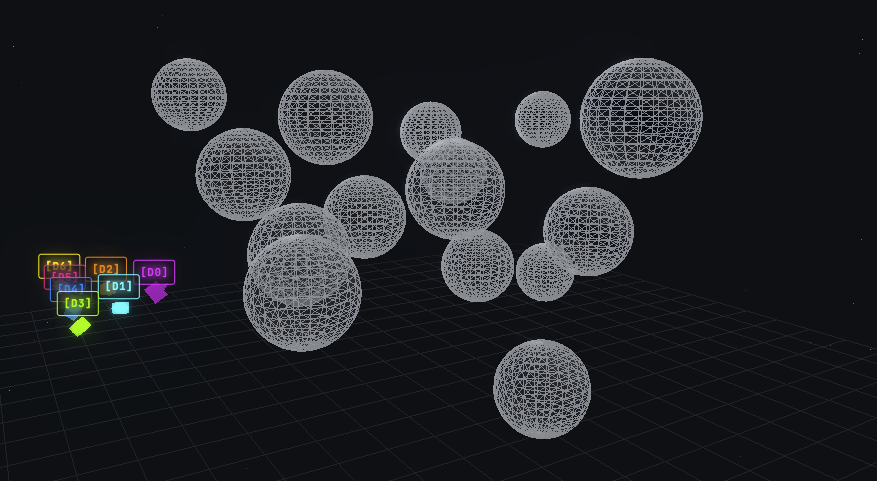
Decentralized consensus formation control with Artificial Potential Fields, LQR-optimal state feedback, and Dryden wind gust rejection. Seven autonomous quadcopters navigate an orbital debris field.
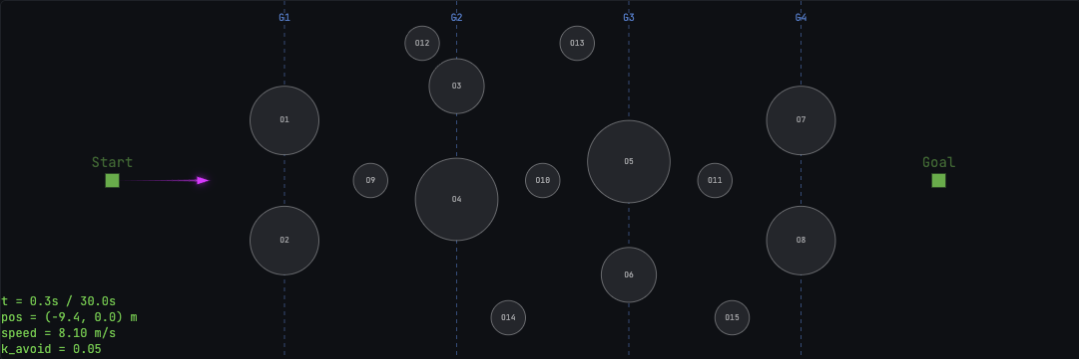
Decentralized multi-agent formation control in cluttered environments requires careful balancing of guidance, collision avoidance, and formation cohesion. This project takes a two-pronged approach to this GNC challenge. The 2D corridor simulation isolates APF path planning in a controlled planar environment, enabling systematic gain characterization, clearance trade-off studies, and Monte Carlo safety analysis across a full parameter space. The 3D simulation extends to full formation flight with cooperative graph Laplacian consensus, LQR optimal control via the continuous algebraic Riccati equation, Dryden wind turbulence rejection, and multi-obstacle negotiation through a realistic debris field. Together, these tools validate core GNC concepts from individual agent guidance to multi-agent coordination—directly transferable to real-world autonomous swarms for search-and-rescue, environmental monitoring, precision agriculture, and orbital debris management missions.
Key Results
- 7–UAV wedge maintains formation through a 90s figure–8 trajectory with 15 spherical debris obstacles, recovering within 2s after Dryden wind gust disturbances
- 2D gain sweep reveals four distinct APF behavioral regimes: corner–cutting (ka < 0.5), local equilibrium stall (ka ≈ 2), optimal slalom (ka = 4), and saturating pushback (ka ≥ 6)
- Optimal ka = 4 achieves 0.52 m minimum clearance through all four slalom gates while maintaining 3 m/s cruise speed
- Monte Carlo analysis across 20 random obstacle layouts validates robust operating envelope at ka ∈ [2, 5], ρ0 ∈ [1.5, 4.0]