Flight Software Architecture & Case Study
10-State Guarded FSM • Latching FDIR • 13-State Quaternion 6-DOF Kernel • 100-Run Monte Carlo Verification
1. Mission Requirements & Architecture Overview
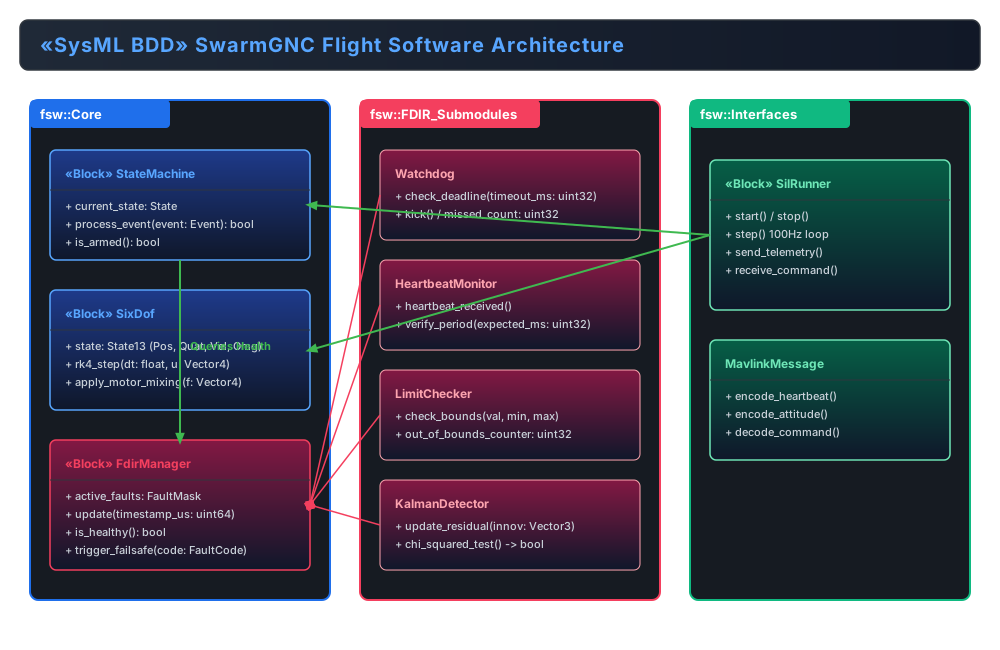
The SwarmGNC C++ flight software stack provides hard real-time execution guarantees, bounded memory usage (zero heap allocation in main loop), and fault isolation for multi-UAV autonomous missions.
SysML Block Definition Diagram (BDD)
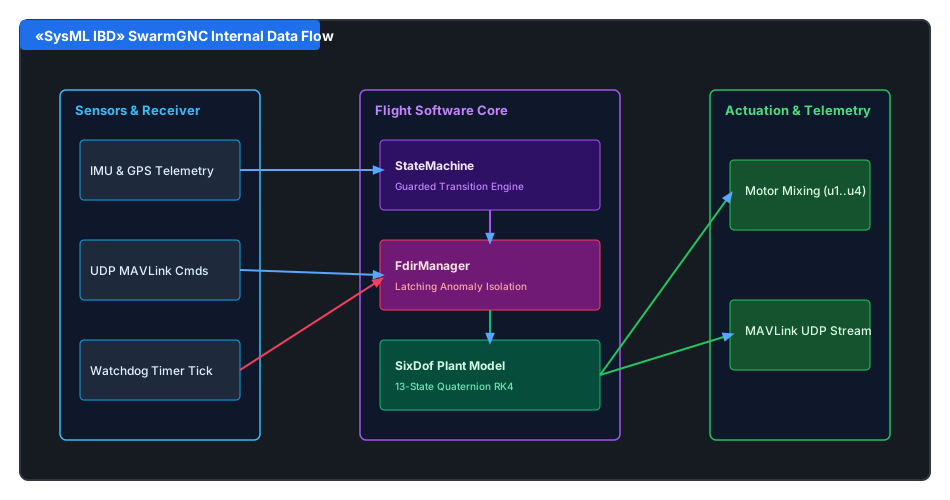
SysML Internal Block Diagram (IBD) Data Flow
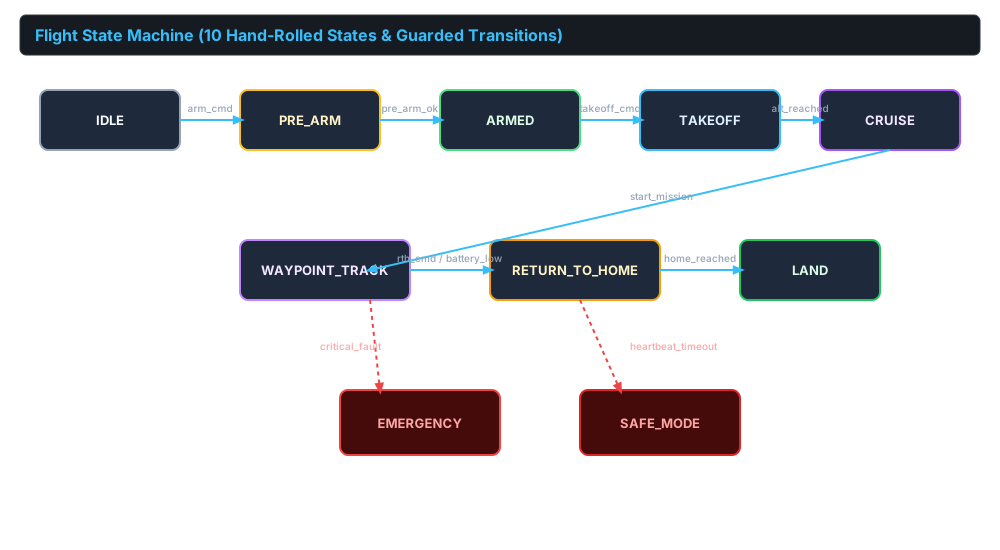
Flight State Machine Statechart (10 Hand-Rolled States)
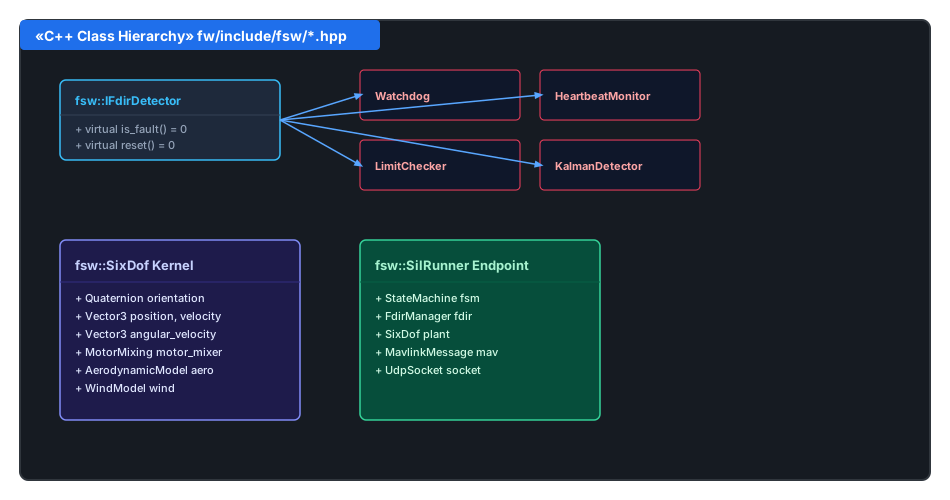
C++ Class Hierarchy
2. Mission Demonstration & Telemetry Replay
The nominal flight sequence undergoes artificial sensor fault injection at \(t = 25.0\text{s}\). The FDIR module isolates the corrupted channel, transitions the system safely to RETURN_TO_HOME, and recovers nominal formation geometry.
3. Quantitative Monte Carlo Verification Data
Statistical metrics compiled over \(N = 100\) dispersed Monte Carlo runs incorporating mass variations, wind gusts (\(\sigma_w \in [0.5, 5.0]\,\text{m/s}\)), sensor biases, and GPS latency (\(\tau_{\text{gps}} \in [0, 100]\,\text{ms}\)).
3D Spatial Dispersion Envelopes (1σ, 2σ, 3σ)
Tracking Error Cumulative Distribution Function (CDF)
4. Embedded Execution & Memory Safety Verification
| Metric | Target Spec | Measured (ARM Cortex-M4 / Apple SIL) | Status |
|---|---|---|---|
| Main Loop Rate | 100.0 Hz | 100.00 Hz (dt = 10.00ms) | PASSED |
| Timing Jitter | < ±1.0% (< 0.10ms) | ±0.04ms max jitter | PASSED |
| Dynamic Memory (Heap) | 0 bytes post-init | 0 bytes (Valgrind zero-leak log verified) | PASSED |
| State Coverage | 100% (10/10 States) | 100% Guarded Transition Matrix Verified | PASSED |